
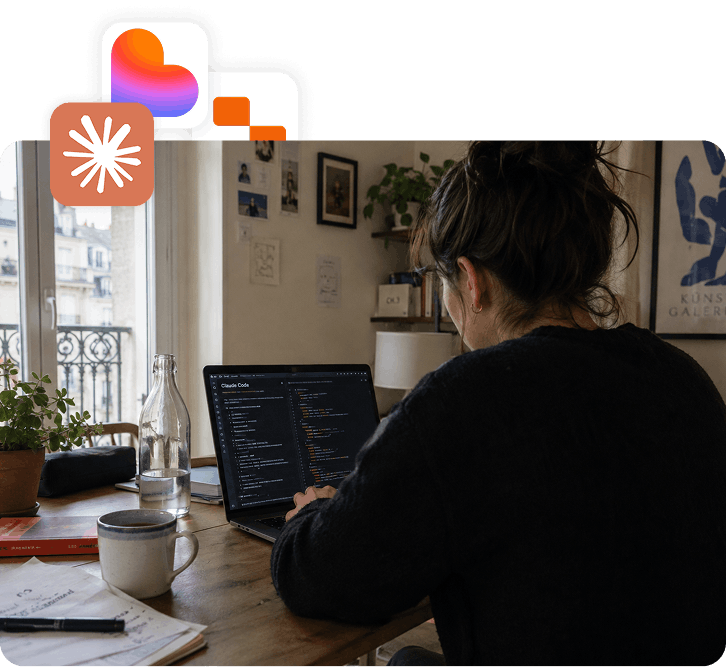
AI can now write software. Tools like Claude Code and Lovable let anyone describe what they want in plain English and get a working application in minutes. A volunteer tracker. A donor lookup tool. A custom dashboard. No engineering team required.
It's called vibecoding, and if you run a political campaign or a nonprofit, someone on your team has probably already tried it. The appeal is there: your team has real problems - data stuck in silos, reports that take too long, field teams waiting on HQ for a list - and suddenly there's a way to solve them overnight.
But here's the question worth asking before you go down that road: even if your team can build an AI tool, is that really the best use of their time?
The gap between "it works" and "I'd trust it"
A vibecoded app can be up and running in an afternoon. But running and trusting are different things - especially when the app handles supporter records, donation data, or volunteer contact information.
The moment your tool touches that data, you're not building a shortcut. You're building infrastructure. And infrastructure carries weight: maintenance when things break in the field, compliance when data privacy laws change, security against breaches that can shatter years of earned trust, and the risk that the one person who understood how it worked moves on to another campaign.
As Eric Wilson recently noted in Campaign Trend, campaigns exist to win elections - not to build impressive technology. Every hour debugging a homemade tool is an hour not spent on the work that actually moves people.
Generic AI doesn't know your supporters
Here's the deeper problem. Most AI tools available today are general-purpose. They can write code, draft emails, and answer questions - but they don't know your data, your operations, or your sector.
When a field director pastes supporter names into a generic AI tool to get a quick analysis, that data leaves their control. When a team builds a vibecoded CRM with AI, they're creating something that looks custom but has no understanding of how organizing actually works - the logic of canvassing turf, the relationship between a donor journey and a volunteer pipeline, the compliance requirements specific to political fundraising.
Generic AI asks you to do the work of making it useful. You provide the context, structure the prompts, clean the output, and hope the data stays secure along the way. That's not AI working for your team. That's your team working for the AI.
AI that was built for the sector
The alternative isn't choosing between building from scratch and settling for something generic. It's choosing AI that was designed inside the platform your operations already run on.
When AI is built into a system that already understands supporter data, field logistics, fundraising workflows, and team structures, the experience is fundamentally different. A team member doesn't need to explain context or structure a query - they type what they need in plain language, and the answer comes from their live data. Search for a group of supporters, generate a report, launch a canvassing action - in one sentence, with no training required.
That kind of AI isn't an add-on. It's operational. It works because it was built for the specific complexity of political and nonprofit organizing - not adapted from a tool designed for everyone and everything.
Control & security isn't an add-on. It should be the foundation.
There's one more thing generic AI and vibecoded tools almost always get wrong: control.
When your AI runs on self-hosted models, your supporter data never leaves your infrastructure and never trains a public model. When your platform gives you a hard switch to turn AI off entirely - and keeps working exactly the same without it - that's not a feature. That's a design principle.
Political and nonprofit teams handle some of the most sensitive data in civic life. The AI they use should reflect that: privacy-first, transparent about what it does, and fully optional. No dependency, no lock-in, no compromise.
Build where it makes sense. Choose wisely everywhere else.
Vibecoding has real uses. Quick internal scripts, a calculator for route planning, a template that saves your team twenty minutes a day - those are fair game. Low stakes, limited data exposure, easy to throw away if something better comes along.
But for the core of your operation - your supporter data, your field coordination, your fundraising engine - you need AI that was built for the work, not AI that you have to build the work around.
The teams that get this right won't be the ones who coded the fastest. They'll be the ones who chose the smartest - and spent their time on the mission instead of the tooling.
→ Learn more about Qomon AI
→ Book a demo