So election day is around the corner, and you’ve been working tirelessly for the past several months. Everything comes down to people coming out to vote. All of those supporters you met and people you convinced? You now have to make sure they get out and vote. Qomon analytics helps you do just that - Get out the Vote!
In this article, you’ll learn how to use Qomon's GOTV tools to help you monitor your win number progress in two steps.
1. Qomon and GOTV
What is GOTV?
GOTV is an effort that political campaigns harness to help increase voter turnout within their supporters.
What do I need to do?
Encourage your volunteers to acquire and mark the “Level of Support” for each contact that they meet on the field (be it from canvassing, phonebanking, flyer handout, surveys... anything!).
Your volunteers can do this directly on the Qomon app for each and every contact made through any of the actions.
If your contact files already include that information, you can import them to your Qomon space directly and our system will sort them accordingly. That way, all of your contact information is consolidated in one place and you’ll be able to use Qomon’s powerful analytic tools to help you strategize.
To know more about how GOTV is made in Qomon, check out our case study right here.
2. Find out what your win number is and don’t lose sight of it!
Calculating your Win Number
Your win number is exactly what it sounds like: the amount of votes you need to bring it home. Sometimes, a simple majority is all you need: 50% (of votes) + 1 = your win number.
To win by a comfortable margin, though, you’ll want to have a vote goal of 53%+1. Use the following formula to figure out your vote goal.
- Find the average turnout of a certain district (e.g. the percentage of voters who usually show up to voting booths)
- Multiply the average turnout percentage by the number of registered voters.You'll get your expected turnout (e.g. the number of people who should show up this time around)
We end up with the following formula:
Expected turnout x 53% = vote goal
Okay. Now that you have your win number and vote goal, what’s next?
1 + 2. Combining GOTV indicators and Win Number
Remember how you or your volunteers indicated the level of support for each contact met on the field ? On your Qomon contact database, you’ll be able see all contacts with their level of support registered. This will help you quantify your GOTV reach, and see how many voters you can count on - statistically speaking. Most importantly, you’ll be able to see how it fares against your vote goal!
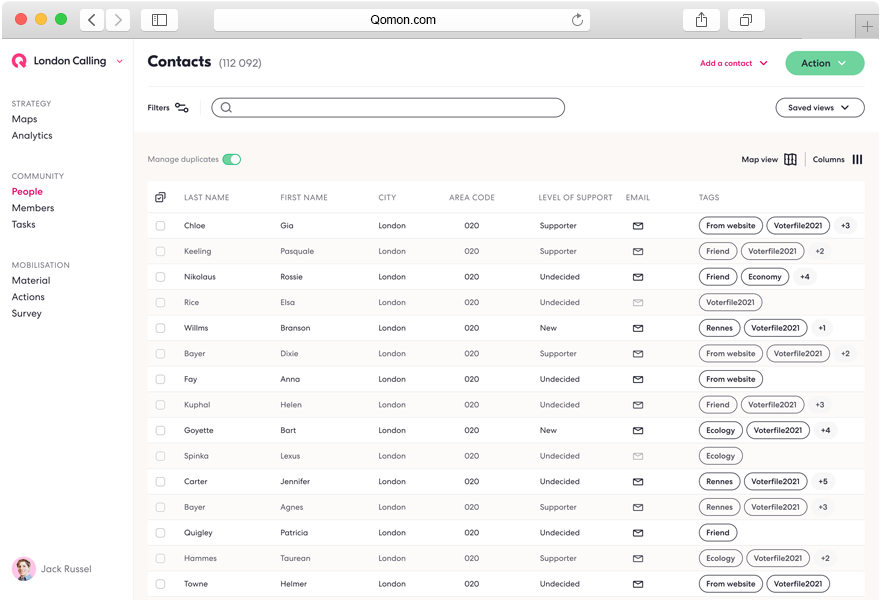
From here, prioritize voters that need more convincing and make sure to not forget your strong supporters.
Convinced? We are too! Book a demo to explore all the other ways Qomon can help you win your next seat - wether it's at the White House or on a school board. And we all know the school board one is a much more interesting matter.