
The best organizing technology shouldn't tell you how to work. It should give you the foundation to build the way your organization actually organizes.
That's the idea behind the Qomon Public API and Qomon MCP. These tools represent something we've always believed: that real power comes from independence, not dependency.
What "API-first" actually means (and why it matters for your team)
If you've heard the term "API" but aren't sure what it means in practice, here's the short version: an API (Application Programming Interface) is a way for different software systems to talk to each other. When a platform is "API-first," it means the platform was designed from the ground up so your data is always accessible, always portable, and never trapped inside a single system.
For nonprofit and political organizations, this is a big deal. Most teams already use multiple tools: an email platform, a donation processor, a spreadsheet for volunteer shifts, maybe a phonebanking tool. An API-first platform means Qomon can connect to the tools you already rely on, rather than forcing you to abandon them or re-enter data by hand.
Being API-first is a commitment to freedom. Open infrastructure means you can connect Qomon to your existing tools, extend it in whatever direction makes sense, and build without getting locked into one system. For organizations that need to move fast and stay flexible, this matters. You shouldn't have to choose between a powerful platform and the independence to build on top of it.
Extend Qomon in whatever direction you need
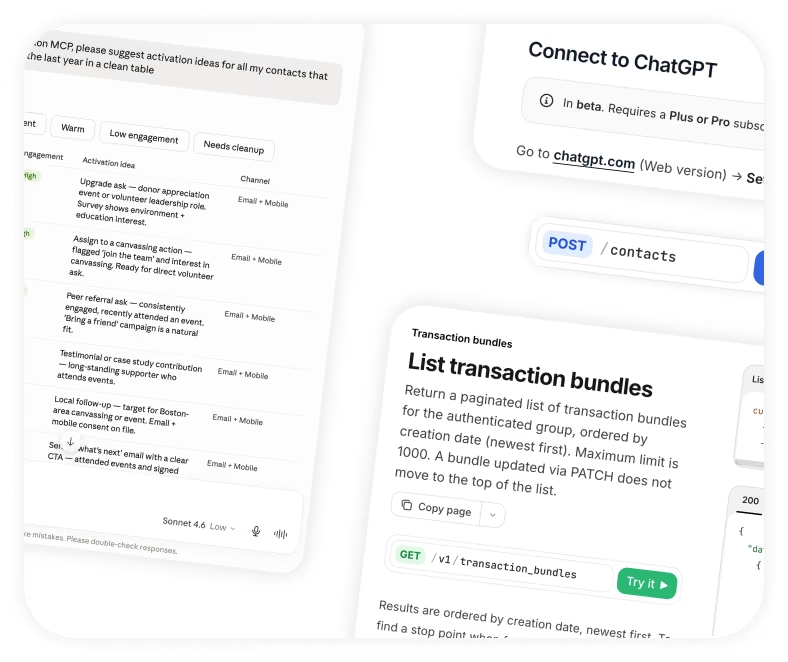
The Qomon Public API gives you full access to contacts, search, actions, users, and fundraising. What does that look like in practice?
A few real examples of what teams can do with the API: sync supporter data between Qomon and your email or communications platform so your lists are always up to date. Automate workflows across systems, like creating a new contact record in Qomon every time someone fills out a form on your website. Build entirely custom dashboards or reporting tools on top of Qomon's infrastructure, tailored to exactly what your team needs to see.
You can also connect Qomon to a data warehouse, feed field action results into your analytics setup, or trigger automated thank-you messages after a donation. The API covers CRUD operations (create, read, update, delete) at no extra cost, which means there's no paywall between you and your own data.
Open access to your data, on your terms.
What is MCP, and what does it mean for organizing?
MCP stands for Model Context Protocol. It's an open standard that lets AI tools connect directly to external platforms and data sources through a secure, structured interface. Think of it as a universal connector between AI systems and the tools your team already uses.
The Qomon MCP lets AI agents and assistants connect directly to your live Qomon data so your team can run analyses, plan field actions, and activate supporters faster. It works with any AI system that supports MCP, which means you choose the tools, not us.
In concrete terms: imagine asking an AI assistant to pull up every supporter who attended a canvassing event last month, cross-reference that with your most active donors, and draft a personalized outreach plan. With MCP, that kind of query runs against your real, live Qomon data, not a stale export or a disconnected spreadsheet.
And if AI isn't part of your stack? Nothing changes. Qomon works exactly the same without it. AI is an option, not a dependency. You stay in control, with full transparency into what's AI-powered and what isn't.
Why open infrastructure matters for nonprofit and political teams
Nonprofit and political organizations have real complexity and limited room for error. They run on tight budgets, lean staff, and urgent timelines. They can't afford to be locked into a system that can't keep up, or one that treats independence like a premium feature.
Too often, organizing platforms make data accessibility and flexibilty too complicated. Exporting a contact list requires a support ticket. Connecting a new tool means waiting for a vendor to build an integration. Switching platforms means starting over. That's not infrastructure built for modern movements.
With the Qomon Public API and Qomon MCP, the goal is to bring teams a strong platform, open infrastructure, and the freedom to build however their organization needs to. Your data stays yours. Your integrations are yours to create. And the way you organize is yours to define.
Ready to get started? Visit the Qomon Developer Hub to set up your API keys, explore the documentation, or connect your first AI tool through Qomon MCP.